.jpg)
For most of the past decade, performance marketing followed a familiar logic. Demand already existed. Consumers searched. Brands intercepted intent. Platforms like Amazon and Google rewarded structure, efficiency, and predictability.
TikTok Shop breaks that logic almost entirely.
What began as a social platform built for entertainment has crossed into something much bigger. With TikTok formalizing its United States future, the platform is no longer an experimental awareness channel. It's becoming a real revenue driver that forces brands to rethink how performance actually works.
This shift matters not only because TikTok Shop is growing fast, but because it changes the definition of performance itself.
Performance No Longer Starts With Intent
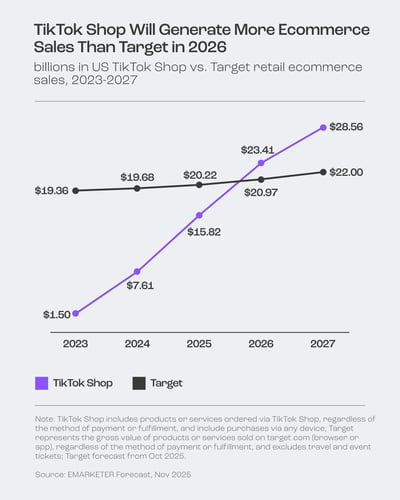 Traditional ecommerce performance is demand capture. Someone wants something. A brand shows up at the right moment. Conversion follows.
TikTok operates upstream from that moment. Products appear before shoppers know they want them. Discovery happens through creators and culture, not search queries. In this environment, performance is about creating demand, not just harvesting what already exists.
This has major implications for ecommerce teams. Media buying alone is no longer enough. Creative, creator relationships, merchandising, and inventory planning now directly influence revenue. Content is the primary conversion engine, not a support asset for ads.
Brands that treat TikTok like another paid channel often fail because they optimize for control rather than momentum. TikTok rewards speed, iteration, and relevance. Perfection kills growth instead of enabling it.
The implication here is structural. Teams built around campaign planning cycles, creative approval processes, and quarterly roadmaps struggle on TikTok. The platform moves too fast. By the time a brand finishes optimizing creative, the trend has passed. Success belongs to brands willing to embrace messiness in exchange for velocity.
Content Becomes the Conversion Layer
Short-form video on TikTok is the product page. The creator, the hook, the comment section, and the social proof all exist in one compressed experience. There is no secondary step driving shoppers elsewhere.
This forces brands to rethink how they measure performance entirely. Traditional metrics still matter, but the signals that predict success look different:
Lagging indicators: Click-through rate, cost per acquisition, return on ad spend
Leading indicators: Creative velocity, creator fit, engagement quality, response speed
For brands that succeed, TikTok becomes a real-time feedback loop. Winning content shapes merchandising decisions before data teams can build reports. Losing content reveals friction in messaging, positioning, or product-market fit before it shows up in sales data. Performance marketing becomes about interpretation and response rather than dashboard optimization alone.
This creates a different skill requirement. The best TikTok marketers are pattern recognizers who can distinguish signal from noise in chaotic data and make decisions with incomplete information.

Volatility Is the New Constant
TikTok Shop introduces a level of volatility that most ecommerce teams aren't built for. A single viral moment can empty inventory overnight. One creator post can outperform weeks of planned media spend. Demand appears in spikes, not steady curves.
This unpredictability changes how brands must think about assortment and supply chain entirely. Not every product belongs on TikTok. The strongest performers tend to be simple, visually clear, and easy to explain in under ten seconds. Brands that bring entire catalogs instead of focused hero products often struggle to maintain momentum.
Performance now includes operational readiness. If fulfillment breaks during a spike, performance breaks. If inventory planning is too rigid, growth stalls when demand arrives. If customer service can't scale quickly, reviews tank and momentum dies. TikTok rewards brands that can absorb volatility, not just those optimized for steady demand.
TikTok Forces a New View of Attribution
 One of the biggest challenges with TikTok commerce is attribution. Influence rarely follows a straight line. A user sees a creator post in their feed, scrolls away without clicking, then days later searches the brand on Amazon and converts through Google after reading reviews.
Last-click thinking is incomplete here. TikTok highlights the growing gap between influence and conversion. Performance teams must zoom out and evaluate blended impact across channels.
TikTok content often lifts:
- Amazon sales
- Branded search volume
- Direct site traffic
- Retail foot traffic
All of this happens even when the final click occurs elsewhere.
For sophisticated brands, this is an opportunity. Those who understand incrementality gain a significant edge over competitors still chasing platform-specific efficiency metrics that miss the broader picture.
Certainty Accelerates Investment
TikTok securing a stable United States structure removes a major barrier for brands that previously hesitated. With regulatory uncertainty easing, marketers can now plan longer-term investments instead of treating TikTok as a risky side bet.
That certainty will likely drive consequences:
- Higher competition as more brands commit budgets.
- Higher costs as ad loads increase and commerce integrations mature.
- Rising CPMs as the era of cheap reach fades.
Execution quality matters more than ever.
This is where agency partners become critical. Strategic operators who help brands adapt to how commerce actually happens now matter more than execution arms focused on single channels.
Certainty Accelerates Investment
TikTok securing a stable United States structure removes a major barrier for brands that previously hesitated. With regulatory uncertainty easing, marketers can now plan longer-term investments instead of treating TikTok as a risky side bet.
That certainty will likely drive consequences:
- Higher competition as more brands commit budgets.
- Higher costs as ad loads increase and commerce integrations mature.
- Rising CPMs as the era of cheap reach fades.
Execution quality matters more than ever.
This is where agency partners become critical. Strategic operators who help brands adapt to how commerce actually happens now matter more than execution arms focused on single channels.
Why This Matters for Modern Ecommerce Teams
TikTok is reshaping the ecosystem around traditional platforms like Amazon and search. Performance marketing now spans inspiration, storytelling, commerce, and fulfillment as one connected system.
For brands, success requires breaking down silos between creative, media, and operations. It requires comfort with imperfection and a willingness to test in public. It also requires partners who understand how platforms interact rather than optimizing each one in isolation.
Channel Bakers sits at the center of this shift as strategic operators who help brands adapt to how commerce actually works now. TikTok Shop is a signal that performance marketing has evolved.
The brands that win will ask how quickly they can learn, respond, and scale when it works.
|



.jpg)
.jpg)